Showing posts with label erp malaysia. Show all posts

Friday, March 10, 2017

Benefits of Enterprise Resource Planning Software (ERP)

Image result for erp software


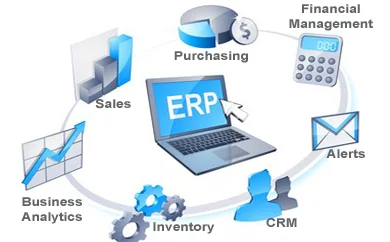
Usually, an organization thinks to implement ERP (enterprise resource planning) software to align business objective with latest technology solutions, to enhance customer confidence and stakeholder commitment, to optimum utilization of organization’s resources and assets. Typically, an organization is looking for good enterprise resource planning software with advance features and functions.


Benefits of ERP Software or ERP system introduces efficiency and improvement of its business processes. Good enterprise software helps you to achieve transparency and availability of data across all business functions. It gives right information at the right time to the right people for effective decision making. This decision would be based on accurate information, which will give positive result and increase productivity.


Image result for erp software
ERP System
ERP software helps you to optimize your human resource management and asset management. It also improves financial management. Trail balance, balance sheet, cash in hand, cash in bank, top supplier, top customer, ABC analysis, dead stock, WIP (work in progress) and other important reports are ready at any point of time. It helps in achieving better efficiency in organization reporting. ERP software streamlines the supply chain management and improves customer relationship management.


Enterprise resource planning software ensures data security and data scalability: organization can customize the enterprise software according to their requirements. It adopts systems that address changing technologies. It gives better ROI (return on investment). Organization can increase turnover with same human resource. There is a misconception that, ERP is for IT department and they will get more benefits, but it is not true. During implementation and after go-live, IT department responsibility is higher than other department. Proper training gives better output from the new system. Lack of proper training to user results wrong entry and create problem. Top management should understand the need of detailed user training. Ultimately, user is going to use this enterprise resource planning software.


More information about ERP System (Enterprise Resource Planning System), visit us @ www.e-soft.my


Monday, February 11, 2013

ERP Software As An Integration Tool


Enterpriseresource planning (ERP) software is a prerequisite for any organization seeking to become an integrated enterprise. In many respects, ERP provides the structural and architectural foundation upon which an integrated enterprise is built.
In a nutshell, ERP is a tool that enables a company to achieve cross-functional integration, transactional efficiency, and timely and accurate reporting.
For example, when a customer accepts a quotation for a product, sales has an ability to convert that quote into a sales order with a click of a mouse. If the terms of an order require pre-payment, the ERP system can be configured to electronically trigger the activation of accounts receivable invoicing functions. From an operational perspective, the order can become visible to an MRP or DRP2  engine  that issues make and/or buy recommendations. And, those recommendations can be converted into a work order or purchase order at the click of a mouse. These are but a few examples of the myriad of opportunities offered by ERP – opportunities to process transactions quickly, efficiently, and with reduced scope for error.
The above scenarios largely focus on processes that can be automated with ERP. Obviously, an organization still needs people to receive and store product, manage the shop floor, and make business decisions. However, it will need far fewer people (and associated payroll expenses) to perform mundane and time consuming data entry and reconciliation tasks. The system can perform those tasks, with greater efficiency, accuracy, and reliability.
An ERP system can accomplish these tasks with precision because it draws upon a single version of data residing in a common database. For example, in an ERP environment, a company isn’t likely to find itself with a sales order that conflicts with an invoice packet. Both document sets will pull common data from the same source, with minimal need for human intervention.
With data stored in a common database, a company can also position itself to achieve timely and accurate BI (business intelligence) reporting. Gone are the days of needing armies of business analysts to export data from various Excel spreadsheets and Word documents into other spreadsheets. Also gone are the days where analysts spend weeks analyzing data only to make recommendations based on data that has since become stale.
With the volatility of markets and the pace of change, today’s businesses don’t have the luxury of time. Decision-making has to be based on analysis of the most current data.
Fortunately, business intelligence tools provide powerful reporting algorithms that can efficiently slice and dice data. Today’s business analysts are no longer mere data miners and aggregators. They can provide value-add in the form of data analysis, data interpretation, and recommendations thereupon.